Free chart · PDF
When do babies sit, crawl, stand and walk?
The age ranges when healthy babies reached four movement milestones in the WHO study, plus CDC timing for smiling, talking and more.
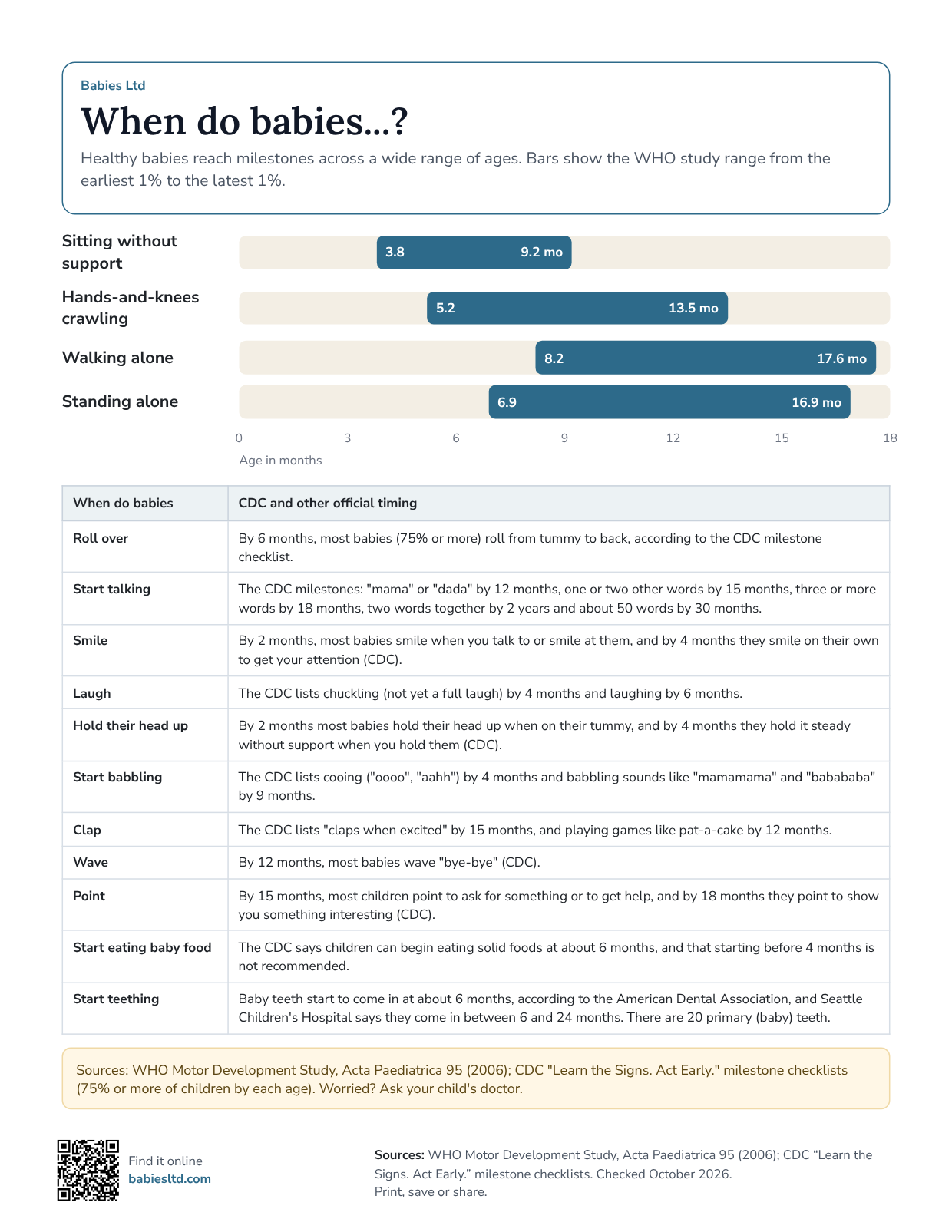
1 page, US Letter size, 34 KB. Free, no sign-up.
Sources: WHO Motor Development Study, Acta Paediatrica 95 (2006); CDC “Learn the Signs. Act Early.” milestone checklists. Checked October 2026.
Share it
PinterestFacebookWhatsAppEmail
Printing tips
- Print at actual size (100%), not "fit to page", so the lines stay a usable size.
- It is laid out for US Letter paper and also fits A4.
- Turn on "background graphics" if the colors come out pale.
What is on this chart
Age in months
| When do babies | CDC and other official timing |
|---|---|
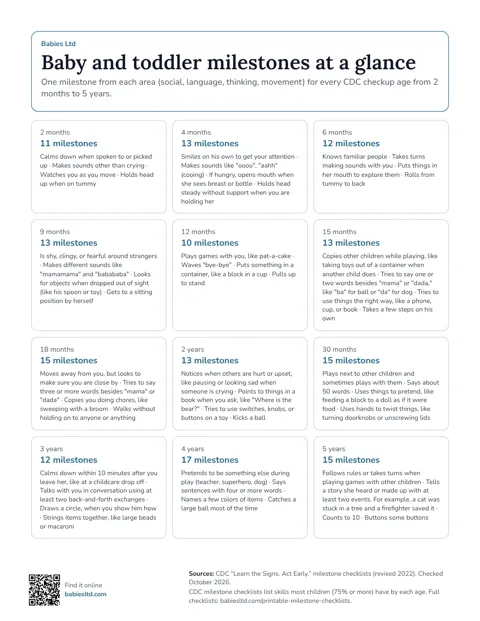
| Roll over | By 6 months, most babies (75% or more) roll from tummy to back, according to the CDC milestone checklist. |
| Start talking | The CDC milestones: "mama" or "dada" by 12 months, one or two other words by 15 months, three or more words by 18 months, two words together by 2 years and about 50 words by 30 months. |
| Smile | By 2 months, most babies smile when you talk to or smile at them, and by 4 months they smile on their own to get your attention (CDC). |
| Laugh | The CDC lists chuckling (not yet a full laugh) by 4 months and laughing by 6 months. |
| Hold their head up | By 2 months most babies hold their head up when on their tummy, and by 4 months they hold it steady without support when you hold them (CDC). |
| Start babbling | The CDC lists cooing ("oooo", "aahh") by 4 months and babbling sounds like "mamamama" and "babababa" by 9 months. |
| Clap | The CDC lists "claps when excited" by 15 months, and playing games like pat-a-cake by 12 months. |
| Wave | By 12 months, most babies wave "bye-bye" (CDC). |
| Point | By 15 months, most children point to ask for something or to get help, and by 18 months they point to show you something interesting (CDC). |
| Start eating baby food | The CDC says children can begin eating solid foods at about 6 months, and that starting before 4 months is not recommended. |
| Start teething | Baby teeth start to come in at about 6 months, according to the American Dental Association, and Seattle Children's Hospital says they come in between 6 and 24 months. There are 20 primary (baby) teeth. |
Sources: WHO Motor Development Study, Acta Paediatrica 95 (2006); CDC "Learn the Signs. Act Early." milestone checklists (75% or more of children by each age). Worried? Ask your child's doctor.